
WhatsApp
International Support Group (ISG)

Navigation

Home Hospitals Doctors Treatments How It Works Medical Guides FAQs
Get A Quote
Cardiology & Cardiac Surgery • Clinical Guide

Transcatheter Aortic Valve Replacement (TAVR / TAVI)

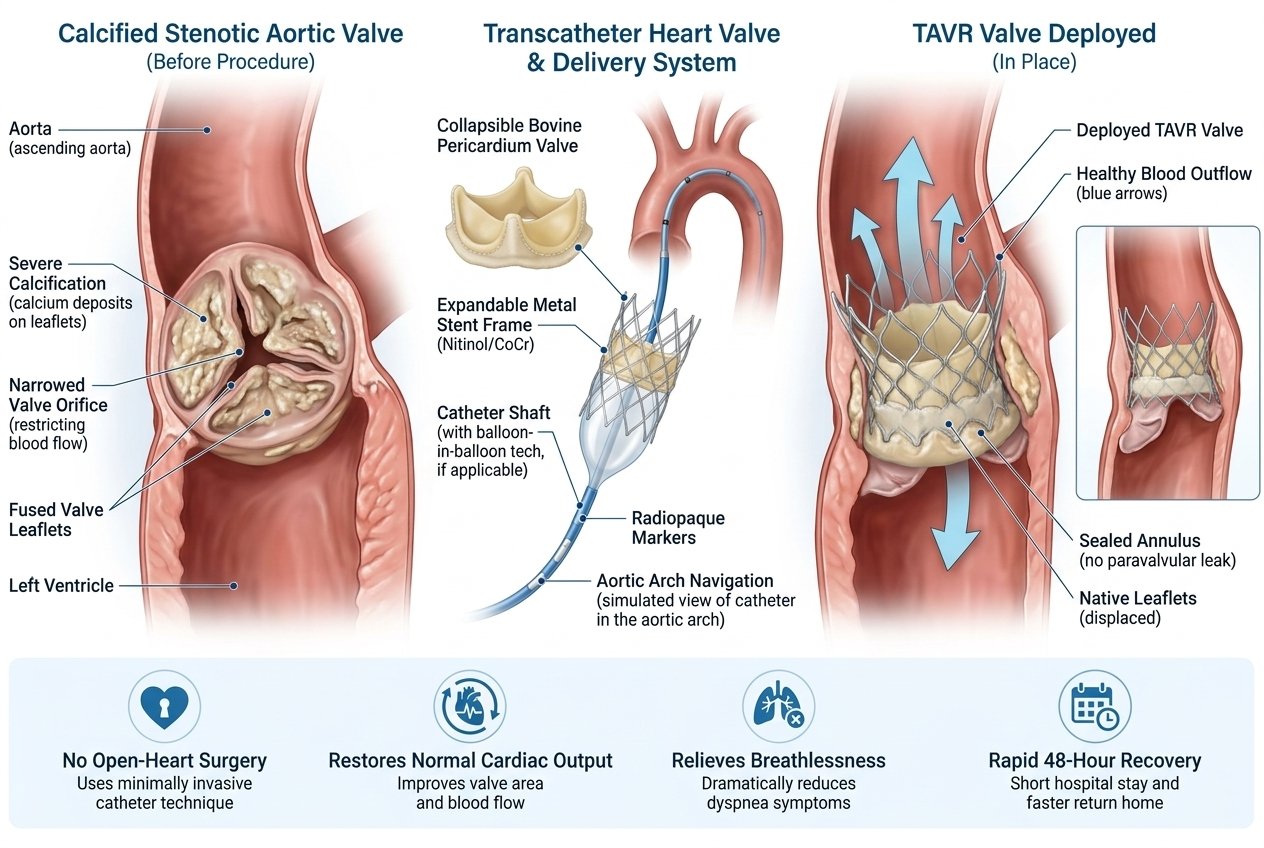
TAVR is a revolutionary percutaneous procedure that replaces a calcified, narrowed aortic valve using a expandable valve catheter inserted through the femoral artery without open-heart surgery.

JCI & NABH Accredited Facilities Direct Hospital Billing Save up to 70–80%
Avg. Cost in India

$18,500

✓ All-Inclusive Hospital Tariff
US / Western Cost

$85,000

Save ~75% to 80%
Typical Inpatient Stay

1 - 2 days

Standard Ward / Private Room
Clinical Efficacy

95%+ Success

JCI Verified Outcomes
TAVR / TAVI — transcatheter aortic valve replacement
Click to Expand
TAVR / TAVI — transcatheter aortic valve replacement Fullscreen View
Clinical Summary

Clinical Overview & Disease Information

TAVR is a revolutionary percutaneous procedure that replaces a calcified, narrowed aortic valve using a expandable valve catheter inserted through the femoral artery without open-heart surgery.

Clinical Insight: Undergoing tavr / tavi — transcatheter aortic valve replacement at our accredited centers provides international patients with access to state-of-the-art navigation robotics, intraoperative neuromonitoring, and world-renowned surgical teams at a fraction of Western costs.

Clinical Manifestations

Signs & Symptoms

Early Symptoms
  • • Mild shortness of breath when walking uphill
  • • Exertional fatigue and dizziness
Common Symptoms
  • • Classic Triad: Angina chest pain, Syncope (fainting), and Dyspnea
  • • Heart murmur detected on auscultation
  • • Severe breathlessness climbing one flight of stairs
Emergency Symptoms
  • • Sudden fainting / loss of consciousness during exertion
  • • Acute pulmonary edema with gasping for air
Etiology & Demographics

Causes & Risk Factors

Primary Causes & Etiology

  • Age-related senile calcific aortic stenosis
  • Congenital bicuspid aortic valve degeneration
  • Rheumatic heart disease valve scarring

Who is at Higher Risk?

  • Elderly adults over 70 years
  • Patients with prior open-heart surgery
  • High-risk surgical candidates with frail health
Pre-Operative Protocol

Diagnostic Evaluation & Testing

Diagnostic Test Clinical Purpose / What It Shows
Multi-Slice ECG-Gated TAVR CT Angiogram Measures aortic annulus dimensions, sinus of valsalva, and femoral access vessel diameter
Transesophageal Echocardiogram (TEE) Measures mean transvalvular pressure gradient (>40 mmHg) and aortic valve area (<1.0 cm2)
Surgical Techniques

Comprehensive Treatment Options

Transfemoral TAVR / TAVI Percutaneous Implantation

Primary Choice

Catheter-based insertion of Balloon-Expandable (SAPIEN) or Self-Expanding (Evolut) prosthetic valve under conscious sedation.

Key Advantages:
No open chest incision
No heart-lung bypass machine required
Discharge home in 48-72 hours
Rapid symptomatic relief

Surgical Aortic Valve Replacement (SAVR)

Complex Cases

Open-heart surgical removal of calcified aortic valve and replacement with mechanical or biological valve prosthesis.

Recommended For:
Younger active patients (< 65 years)
Concomitant multi-vessel CAD requiring CABG
Aortic root enlargement needed

Advanced Medical Technologies Available in Partner Hospitals

Edwards SAPIEN 3 Ultra Valve Medtronic Evolut PRO+ Self-Expanding Valve Sentinel Cerebral Embolic Protection Device
Clinical Risk Warning

Possible Complications If Untreated

Vascular access site bleeding / hematoma
Complete heart block requiring permanent pacemaker
Paravalvular leak
Stroke
Post-Operative Milestone

Recovery Timeline, Diet & Lifestyle Care

Recovery Timeline

Procedure / Stage Expected Recovery Duration
Procedure & Cath Lab Recovery 2 to 4 hours
Step-Down Cardiac Ward Walking 24 hours
Hospital Discharge Home 48 to 72 hours
Full Active Driving & Normal Routine 2 weeks

Recommended Post-Treatment Diet

  • Low sodium heart healthy diet
  • Adequate hydration
  • High protein recovery foods

Essential Lifestyle Changes

  • Daily walking
  • Avoid heavy lifting > 5kg for 2 weeks
  • Keep groin catheter site clean and dry
When to Contact a Doctor Urgently:
Groin swelling, redness or active bleeding
Dizziness or fainting spells
Sudden shortness of breath
Long-Term Health

Prevention & Long-Term Health

Annual echocardiography for known bicuspid aortic valve
Strict blood pressure control
Transparent Benchmark

Global Cost Comparison Matrix

Procedure USA (Avg) India (ISG Network) Turkey (Avg) Thailand (Avg)
TAVR / TAVI — transcatheter aortic valve replacement $85,000 $18,500 $25,000 $28,000
Patient Knowledgebase

Frequently Asked Questions

How long does a TAVR valve prosthesis last?

TAVR tissue valves demonstrate excellent durability lasting 10 to 15+ years.

Is TAVR performed under general anesthesia?

Most TAVR procedures are now performed under local anesthesia with light conscious sedation.

TAVR / TAVI — transcatheter aortic valve replacement
Press Esc or click anywhere outside to close
24/7 International Patient Coordination

Need Help Planning Your Medical Travel?

Connect directly with our patient coordinators for multi-hospital cost comparisons, specialist doctor opinions, and medical visa invitation letters — 100% free with zero facilitation fees.